
Overview & Profile
The amylin and calcitonin receptors play an important role in food intake and metabolic control, making them attractive therapeutic targets for obesity. The company believes that agonism of the amylin pathway could play a key role in developing therapeutics for use in combination with GLP-1 or dual GLP-1/GIP agonists. Amylin agonists could represent attractive treatment options for patients who are not candidates for GLP-1 therapeutics due to tolerability or other reasons.
Viking is developing a series of novel amylin receptor agonists and plans to file an investigational new drug (IND) application for this program.
About
About Amylin and Dual Amylin and Calcitonin Receptor Agonists (DACRAs)
The amylin and calcitonin receptors play an important role in food intake and metabolic control, making them attractive therapeutic targets for obesity. The company believes that agonism of the amylin pathway could play a key role in developing therapeutics for use in combination with GLP-1 or dual GLP-1/GIP agonists. Amylin agonists could represent attractive treatment options for patients who are not candidates for GLP-1 therapeutics due to tolerability or other reasons.
Viking is developing a series of novel amylin receptor agonists and plans to file an investigational new drug (IND) application for this program.
Preclinical Data
Viking presented a poster2 (2024-LB-5842) with preclinical data from a series of internally developed dual agonists of the amylin and calcitonin receptors at the 84th Scientific Sessions of the American Diabetes Association (June 2024)3. The presentation highlighted the effects of treatment on body weight, food intake, and metabolic profile in healthy rats and diet-induced obese (DIO) mice as compared to control cohorts treated with vehicle, or the dual amylin and calcitonin receptor agonist cagrilintide.
The study results demonstrated that Viking’s series of dual amylin and calcitonin receptor agonists (DACRAs) reduced food intake in lean rats in the period from 0 – 72 hours following a single subcutaneous dosing. At 72 hours following a single subcutaneous dose, Viking’s novel compounds resulted in up to 8% body weight reductions compared to vehicle-treated animals2.
In a DIO mouse model, treatment with Viking’s series of co-agonists for 24 days resulted in body weight reductions that were comparable to those achieved in cagrilintide-treated animals. Additionally, improvements in key metabolic markers, including blood glucose levels, were observed in DIO mice treated with the company’s compounds for the 24-day time period2.
Some highlights from poster 2024-LB-5842 (“Novel Amylin and Calcitonin Receptor Co-Agonists Reduce Food Intake and Body Weight in Rodents”) are shown below3:
- Viking DACRAs demonstrated EC50 values ranging from low nM to micromolar on the human amylin 3 receptor and a similar range of potencies on the human calcitonin receptor.
- Treatment with single doses of Viking DACRAs resulted in up to 8% mean reductions in body weight in lean rats after 72 hours.
- Treatment of DIO mice for 24 days with Viking DACRA compounds demonstrated up to 10% weight loss from baseline (p<0.05 vs. baseline).
- Viking DACRA compounds demonstrated up to 24% reductions in blood glucose in DIO mice after 24 days (p<0.05 vs. baseline and cagrilintide control).
These data demonstrated the potent activity of a series of novel, internally developed, amylin and calcitonin dual agonists and represented an exciting expansion of our pipeline in obesity and metabolic diseases. The results of these and other preclinical studies provided the rationale for Viking’s continued advancement of its internal dual amylin and calcitonin receptor agonist development program. This program provides Viking with additional opportunities to develop novel, differentiated therapies for obesity with potentially best-in-class profiles.
An Overview of the Major Actions of Amylin
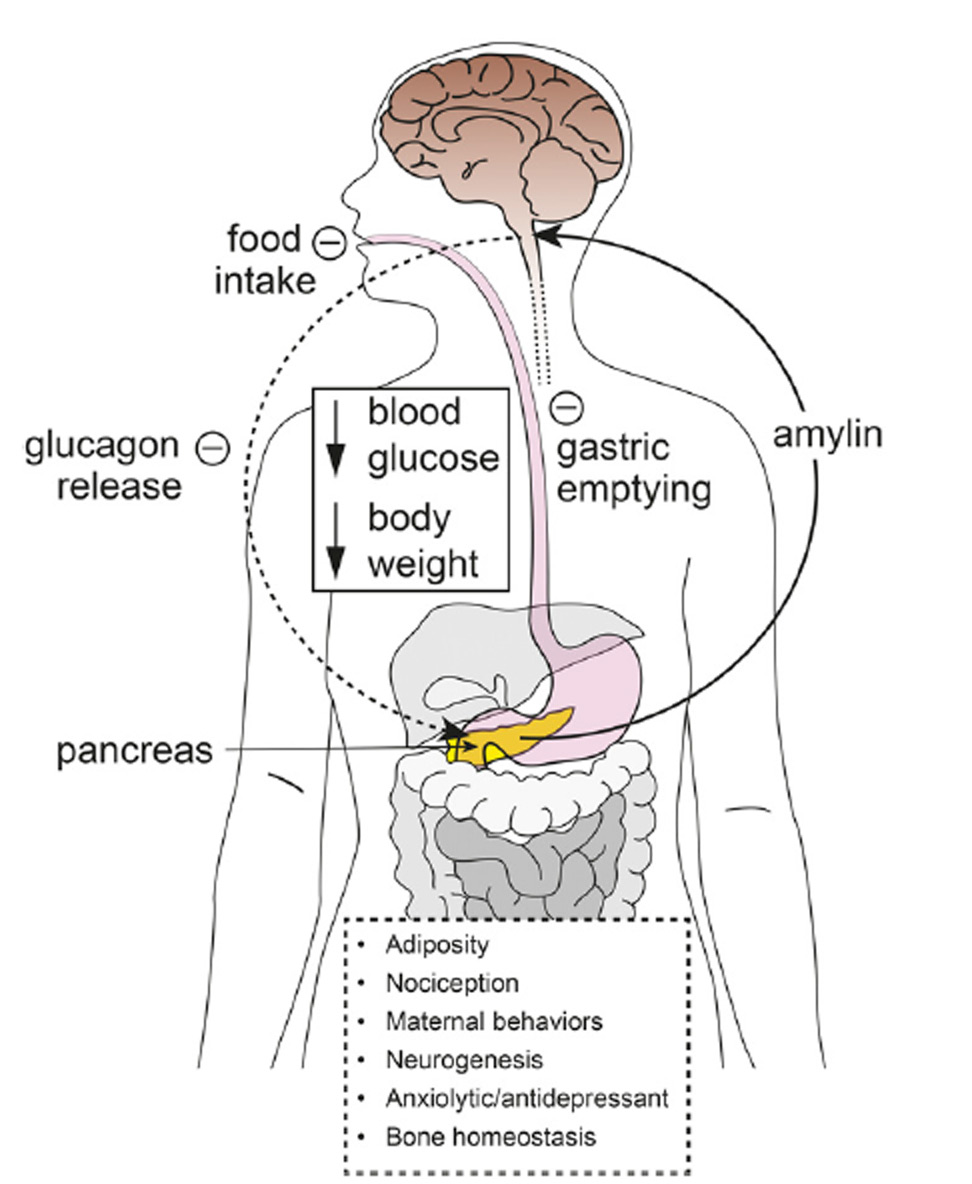
Hay DL, Chen S, Lutz TA, Parkes DG, et al. Amylin: Pharmacology, Physiology, and Clinical Potential. Pharmacol. Rev. 2015; 67 (3):564–600 (link)
Amylin, secreted from the pancreas after a meal, circulates in the blood to activate specific receptors in the brainstem. This results in suppression of glucagon release from the pancreas, a reduction in food intake, and gastric emptying. The net effect of these actions is to decrease blood glucose, associated with longer term reductions in body weight. The most well-established effects of amylin are shown in the box with a solid line. Less well-defined effects of amylin are shown in the dashed box1.